India Yogashala

Author name: Prashant Jakhmola

Prashant Jakhmola is a passionate yoga teacher dedicated to helping students connect with the deeper essence of yoga beyond the mat. With years of personal practice and teaching experience, he combines traditional wisdom with a modern approach to make yoga accessible for everyone

yoga poses for two people
Blog, Yoga Poses

Yoga Poses for Two People: A Guide to Couple Yoga

Yoga is a mindful journey of inwards, a deep conversation between your mind, body, and breath. When another person joins you in this journey of wellness, you will feel something magical happening to you. Practicing yoga can be a shared language which later turns into a practice of laughter, presence, support, and trust. Partner yoga is a collaborative experience where you learn to balance yourself with someone, find stillness and breathe with them together. It is a fun way to elevate your yoga practices and enhance its overall results. Whether you are practicing with your friend, partner, or a family member, this two-person yoga is a nice way to connect with each other, physically, mentally, and emotionally. This blog is all about how partner yoga works and what makes it so powerful. Here, understand the step-by-step details about the 12 best partner yoga poses and how to perfectly practice them.  What is Partner Yoga (Couple Yoga)? Couple yoga, also known as partner yoga, is the practice of performing yoga poses with two person, using each other’s bodies for support, balance, and deeper stretches. Unlike traditional solo yoga, partner poses require coordination, communication, and trust between both participants. It’s important to distinguish couple yoga from acro yoga. While both involve two or more people, acro yoga incorporates acrobatic elements with one person typically lifting or balancing the other in more advanced, gravity-defying positions. Couple yoga, on the other hand, focuses on accessible poses that emphasize connection and mutual support rather than impressive aerial feats. The philosophy behind partner yoga centers on shared energy and the concept that two people practicing together can achieve more than they might individually. This practice creates a feedback loop of support—when one partner struggles with balance, the other provides stability; when one needs encouragement, the other offers presence. This mutual reliance fosters emotional bonding and teamwork that extends far beyond the yoga mat. Benefits of Partner Yoga Poses Partner yoga is a shared experience where two people practice together to build their strength and improve their poses alignment. This yoga type combines the traditional asanas with some mindfulness, acrobatics, and breathing in synchronization. Let’s understand the different benefits of partner yoga before diving into the 12 specific poses-  1. Enhances Communication Communication is one of the major benefits of practicing partner yoga as it emphasises you to tune in with your partner both emotionally as well as physically. Every movement practiced will require a rhythm that is shared. You then start to give feedback to each other in the non verbal form and start sensing the other person’s energy. With the help of this, you can build better communication and understanding with each other.  2. Deepens Connection When you practice together, you start breathing, stretching, and balancing together with each other. You need to build trust and cooperate with each other while performing different asanas. Being communicative and building connections helps in staying fully present to align movements. This way you can create an effective impact on your relationship with your partner. Especially, if you are practicing it with your significant other, then it will help you increase emotional intimacy as well as empathy.  3. Improves Balance and Alignment When you start practicing asanas correctly, partner yoga helps you to align your body more clearly. Your partner will be a mirror and stabilizer while practicing with you, which will ultimately refine your postures in a way that is hard to achieve when you are practicing alone.  4. Increases Flexibility and Strength Partner yoga increases your strength as well as flexibility in a more enhanced way. Your body is prepared by practicing some stretches together. You can improve your body’s balance while practicing the dynamic asanas with your partner in order to increase flexibility and overall strength of your body.  5. Encourages Mindfulness and brings Joy When two people are practicing yoga together, it requires attention from both the people. This shift in position is a part of meditation. Then there are some poses which will make you fall or laugh together, this is the fun part. These moments during partner yoga reduces your stress and brings utmost lightheartedness into your practice The Basics of Hatha Yoga: 10 Classic Poses for Strength and Balance 12 Best Yoga Poses for Two People Let us now begin talking about the 12 yoga poses which are majorly beneficial and can build your trust, strength, as well as emotional compatibility. Whether you are a beginner or an advanced practitioner, these poses can be adjusted and practiced according to your comfort level.  1. Seated Centering (Easy Pose with Partner) Source This pose sets the foundation for your partner yoga session. It encourages mindfulness, synchronization, and a sense of shared presence. Sitting face-to-face allows you to connect through breath and energy, creating harmony between both partners. It’s a gentle reminder that yoga is not just about physical alignment, but also emotional and energetic attunement with each other. How to Do It: Sit cross-legged back-to-back with your partner, ensuring your spines are touching from tailbone to upper back. Rest your hands on your knees or in your lap. Close your eyes and begin to notice your partner’s breath against your back. Gradually work to match your breathing patterns, inhaling and exhaling together. Sit in this connected state for two to three minutes, setting an intention for your practice together. Focus & Tips: Feel the rise and fall of your partner’s ribcage with each breath. Allow your spines to support each other equally—neither person should lean heavily backward. This pose is about mutual support and presence. Benefits: Establishes a calm, connected foundation for your practice. Synchronizes breathing patterns and heart rates. Promotes mindfulness and present-moment awareness. Helps both partners transition from the external world into a shared practice space. 2. Partner Forward Fold Source A deeply grounding pose, Partner Forward Fold promotes mutual flexibility and trust. It’s an excellent way to open up your hamstrings and lower back while relying on your partner for
yoga statistics
Blog, Yoga

Yoga Statistics 2026: How Many People Do Yoga Worldwide?

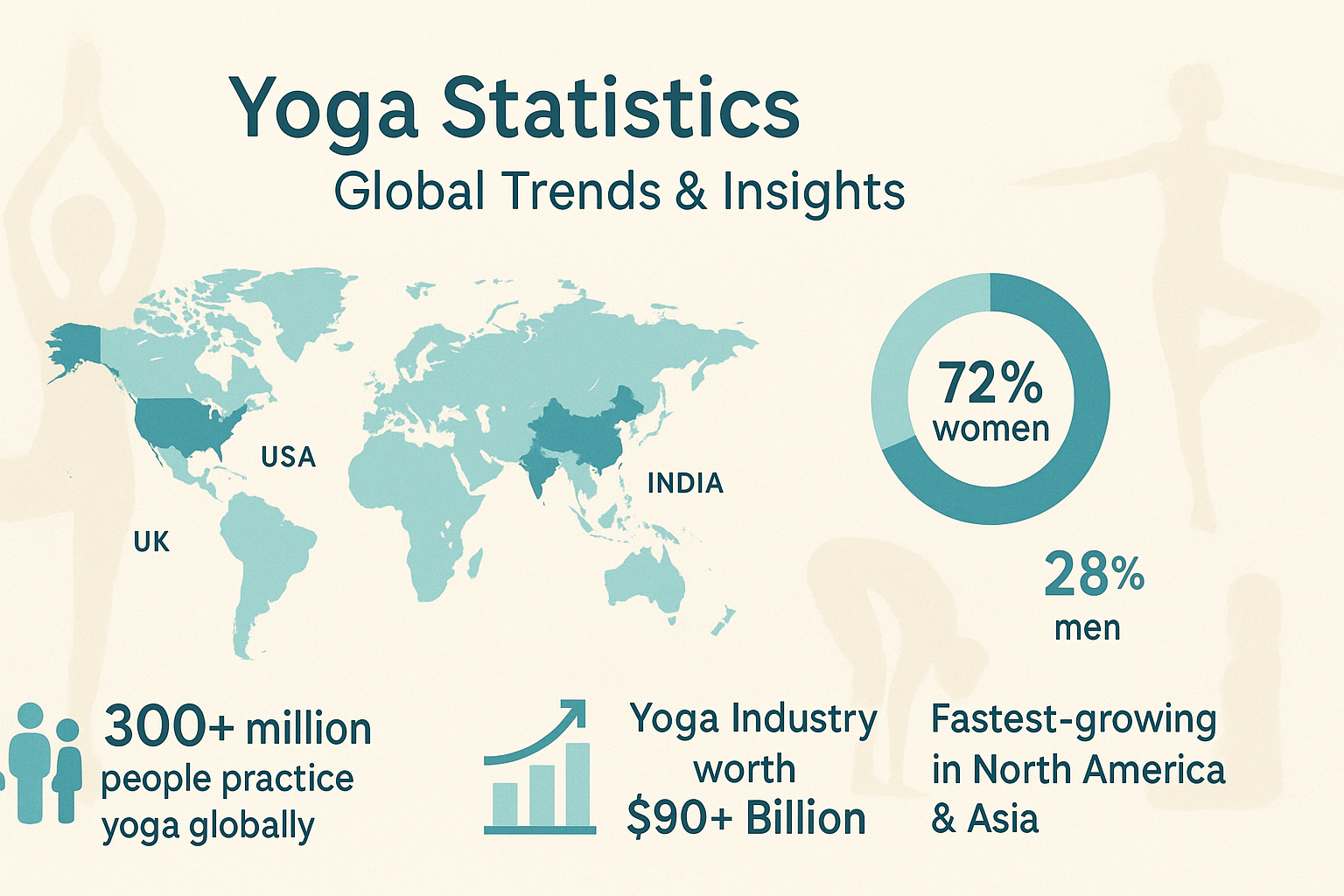
Yoga has come a long way from its roots in ancient India. What started thousands of years ago as a spiritual and meditative practice is now a global wellness movement loved by millions. Today, yoga isn’t just about stretching or meditation — it’s a way for people to manage stress, stay fit, and find balance in their busy, tech-filled lives. This article looks at the latest yoga statistics around the world, how many people are practicing it, where it’s growing fastest, and what the future of yoga looks like as we move toward 2030.  The numbers come from trusted sources like Yoga Alliance, Statista, and the Global Wellness Institute. Key Takeaways (Quick Facts) How Many People Practice Yoga Worldwide? As of 2025, more than 300 million individuals practice yoga regularly worldwide. This represents a remarkable expansion from previous decades. Between 2010 and 2021, yoga’s popularity surged by 63.8%, demonstrating accelerating adoption rates that show no signs of slowing. To put this in perspective, the global yoga community now rivals the population of the United States. This massive practitioner base spans every continent, age group, and socioeconomic background, reflecting yoga’s universal appeal and adaptability. The number of yoga studios has also expanded dramatically, with currently 48,547 yoga and pilates studios operating in the United States alone. Additionally, more than 100,000 teachers are registered with Yoga Alliance, though the actual number of yoga instructors globally is significantly higher when including unregistered teachers and traditional practitioners. Regional Distribution The global yoga landscape features distinct regional characteristics and growth patterns: Asia-Pacific: The Asia-Pacific region accounts for approximately 37.2% of the global yoga market revenue, making it the largest regional market. India, as yoga’s birthplace, maintains the highest percentage of practitioners relative to population, though China and Japan are experiencing rapid growth. Japan has witnessed a 413% increase in yoga practitioners over the last five years. North America: North America represented 27.3% of the global yoga market in 2023, with the United States serving as a major driver of both practice and innovation. The region leads in premium yoga products, teacher training programs, and digital platform development. Europe: European nations show steady growth with particular strength in Germany, the United Kingdom, and increasingly Italy. Italy is emerging as the fastest-growing regional market, while wellness tourism centered around yoga is expanding in Spain, Portugal, and Greece. Latin America: Countries like Brazil and Mexico are experiencing increasing yoga adoption, particularly among younger demographics interested in fitness and mental health. Latin America is expected to account for about 10% of the global yoga market by 2025. Australia & Oceania: Australia has a well-established yoga culture with high per-capita participation rates. The country currently has 3,314 yoga studios, representing significant market penetration for its population size. Countries By Most Number Of Yoga Practitioners While exact practitioner numbers by country remain challenging to verify due to varying survey methodologies, the following countries represent the largest yoga communities based on available data and market analysis: Rank Country Estimated Practitioners % of Population Market Characteristics 1 🇮🇳 India 50-70 million 4-6% Birthplace of yoga; traditional and modern styles coexist; rapidly growing wellness tourism; strong government support 2 🇺🇸 United States 36-42 million 10-11% Largest commercial market; high consumer spending; innovation hub; diverse style offerings 3 🇨🇳 China 30-40 million 2-3% Fast-growing market; increasing urban adoption; hybrid Eastern-Western approaches 4 🇧🇷 Brazil 5-8 million 2-3% Growing Latin American leader; young demographic base; fitness-oriented approach 5 🇬🇧 United Kingdom 4-5 million 6-7% Mature market; strong studio culture; wellness integration 6 🇩🇪 Germany 3-4 million 4-5% Health-focused approach; insurance coverage for yoga therapy 7 🇨🇦 Canada 3-4 million 8-10% High per-capita participation; similar trends to US market 8 🇦🇺 Australia 2-3 million 8-11% Very high per-capita rates; outdoor yoga culture; premium market 9 🇯🇵 Japan 2-3 million 2-3% Fastest regional growth rate; corporate wellness integration 10 🇫🇷 France 2-3 million 3-4% Growing European market; wellness tourism destination Demographics of Yoga Practitioners Gender Distribution Women make up the majority of practitioners, representing 72-80% according to different surveys. This gender distribution reflects yoga’s Western popularization primarily through female adoption, particularly during the 1970s through early 2000s. However, the landscape is evolving. Between 2012 and 2016, the number of men practicing yoga in the United States grew from 4 million to 10 million, marking a 150% increase. Male participation is steadily increasing, especially in countries like India and China, where the split is closer to 60:40. Several factors are driving increased male participation: Age Distribution The largest group of yoga practitioners falls within the 30-49 age range, representing the core demographic. However, yoga’s reach extends across the entire age spectrum with notable trends: Ages 18-29 (Young Adults & Millennials): Millennials and Gen Z practitioners make up about 55% of all yoga practitioners in 2025. This group is particularly drawn to digital offerings, social aspects of practice, and fitness-oriented styles. They drive trends in online classes, app-based subscriptions, and social media yoga content. Ages 30-49 (Core Practitioners): This demographic represents the most consistent and dedicated practitioner base. They typically have higher disposable incomes, attend classes regularly, and invest in premium equipment and retreats. Ages 50-64 (Active Seniors): The number of over-50s practicing yoga has tripled over the last four years. This group seeks yoga primarily for flexibility, joint health, stress reduction, and chronic pain management. Ages 65+ (Older Adults): In 2022, 8.0% of adults age 65 and older practiced yoga. Adaptive yoga and chair yoga are helping older adults stay mobile and connected, making yoga increasingly accessible to aging populations. Children & Teens: Schools are increasingly incorporating yoga, breathwork, and mindfulness into curricula. Statistics show that children are more likely to take part in yoga if one of their parents does, with 37% of yoga practitioners having children who also practice. Location Demographics Urban vs. Rural: Yoga participation remains highest in urban and suburban areas where studio access, class variety, and community support are most robust. However, online platforms are rapidly democratizing access to rural and remote areas.

how to prepare for yoga teacher training
Blog

How to Prepare for Yoga Teacher Training: What to Know Before You Go

Yoga teacher training is a life-changing program to commit to. It might begin as a curiosity or a desire to deepen your yoga practice but what will surprise you is how much more you can take from it. By the time you graduate from the program, you will walk away with a fresh perspective of your life, body, and surroundings. Preparing yourself for a yoga teacher training program is not only about researching logistics or deciding your destination, it is also to learn how to incorporate yoga in your daily life and train your mind as well as body for handling the long hours of practice.  When you start your YTT journey by being fully prepared, you are going to thrive on your experiences. Building strength, flexibility, calming your mind, and setting realistic expectations are going to keep you grounded when the program starts to feel heavy. Once you are prepared, it helps you to fully absorb the teachings and also become the most confident as well as centered version of yourself. In this guide, you will learn how to prepare yourself before joining a yoga teacher training program.  Understand What Yoga Teacher Training Actually Is Before you jump into the decision of joining the yoga teacher training program, make sure you are crystal clear about what it actually is. Many people think of this as an extended yoga retreat which is about detoxifying, rejuvenation, and some perfect Instagram-worthy poses. But yoga teacher training is a rigorous program from the moment you arrive. Your days are planned, scheduled, and structured and the students are expected to be disciplined as well as committed enough.  The early mornings start with meditation or pranayama while watching the sunrise, then long asana sessions. Then you spend your other half of the day off the yoga mat, understanding the yogic philosophy and exploring the anatomy of a human body. Yoga teacher training is about showing up everyday with the same discipline and focus to grow. You will feel exhausted and intimidated on some days but that is a part of the process. This is what makes the entire journey transformative and enlightening for you. It gives you a chance to escape from your old patterns and reconnect with your true self on a deeper level. If you are passionate about teaching yoga and sharing its wisdom to others, then this is the perfect opportunity to build the skills required for it.  Start Building your Personal Yoga Practice By starting your personal practice before you start the yoga teacher training program, you will get one step clearer during your training period. You can easily absorb all the teachings as you are already familiar with yoga. This doesn’t mean that you need to have the ability of floating into a headstand or nail the advanced postures. What matters is that you have consistency and a habit of always showing up on your yoga mat.  Building yoga practice before joining the YTT program is important for two reasons. First is that your body will be grateful to you for putting it into a habit of performing asanas daily. Yoga teacher training is a rigorous program which requires you to physically practice for several hours. If your body is not in a habit of moving regularly, then you might feel uncomfortable and wiped out during your training. So it is recommended to start your personal practice at least 6-8 months prior to the actual program.  Secondly, building personal yoga practice and preparing your body will also help you  stay mentally disciplined. You should always remember that training is not only about physical posture but also about showing up everyday even if you are tired or not in the mood. Incorporating this habit of practicing daily will serve you during the tough times in your training journey. If you are not sure about when you are starting, just add some short home yoga practices to your days and mix it with pranayama and meditation. By the time your program starts, you will feel more prepared and stronger to step on the mat with confidence.  Also Read: How Much Time Does It Take to Become a Certified Yoga Teacher? Getting Familiar with the Yogic Philosophies In your yoga teacher training program, be it the foundational or the advanced course, there will be lessons on yoga philosophies. These are important to understand as it is the base of every yogic aspect. That is why starting to read these philosophies and teachings before you start your program will help you be ahead of your time in this journey. Explore the chapters and ancient text and build a familiarity so that when your instructor mentions the terms dharana, prana, or samadhi, you are not confused about it.  Some approachable options to read the yoga sutras are the Bhagavad Geeta, Hatha Yoga Pradipika, and Patanjali Yoga Sutras. These texts outline the deeper purpose of yoga and teaches you the spiritual path of this journey. You can also listen to some podcasts or watch YouTube videos which break down the ideas mentioned in these traditional textbooks. By providing a headstart to yourself with yogic philosophy, you will be walking into the yoga teacher training program with curiosity and questions, not with an overwhelming nature. Improve your Lifestyle Several yoga schools emphasize on living a sattvic life. This means that you should eat clean, keep your habits simple, and live your life in a way that makes you feel lighter from mind as well as body. It is about creating a surrounding for yourself where you have steadiness supported and your mind is more present. Try to improve your lifestyle or bring some sustainable changes before you start your YTT journey as it will prepare you for the future changes. The first thing to improve is the food you consume. If you are someone who loves having heavy and processed meals, lots of caffeine beverages, and late-night snacking, then these habits lead you to feeling sluggish

Deepening your Own Practice
Uncategorized, Blog

How to Start Teaching Yoga: Tips for New Instructors

Starting your professional career as a yoga teacher can be extremely overwhelming but also exciting. When you have spent the required hours completing the yoga teacher training, stepping out of the student role and becoming a teacher feels like a whole new universe. But the truth is, every yoga teacher feels the same way before starting their teaching career.  Always remember that teaching is not about knowing every posture, it is about guiding others for a healthier lifestyle through practice. In the beginning, think about being more thoughtful, authentic, and real for your students rather than being the perfect instructor. You already know the basics but you have to boost yourself through some real-world experiences.  Teaching yoga can be extremely rewarding as well. Sharing the yogic wisdom and watching others having benefits out of it because of your guidance is something you will always remember. This blog will tell you everything about how you can start teaching yoga as a beginner who just completed their certification.  Set Your Foundations Perfectly Know your role You should understand that you are a yoga instructor, neither a doctor, nor a physio. Your job is to guide your students regarding bodily movements, attention, and synchronized breathing. You are not responsible for diagnosing diseases or prescribing medicines. Encourage your class to listen to their bodies and if they have serious issues then recommend them to consult a doctor.  Ethics and Consent Sharing the wisdom of yoga and teaching its practices also means that you are going to work with people’s bodies as well as emotions. It is important to prioritize and have clear consent before starting your sessions. Respect the boundaries of your students as it will help you in building trust.  Insurance and Legal Basics You might need liability insurance depending on where you are teaching. This insurance will help you if a student gets injured in your class during the asana practice. Always make sure to provide a safe and supportive environment to your students so that there are no injuries but also have insurance as a safety net in case you need it.  Discover your Teaching Voice Always remember that your words are your primary teaching tool, which will lead the room while you teach.  Practice Clear Cueing Learning to give clear cues is extremely important while teaching yoga. It is just about giving simple and short instructions which are easy to understand as well as effective while practicing yoga. This skill will start getting better once you start having multiple sessions of teaching yoga. The more you teach, the more fluent you become in giving clear cues to your students.  Find Your Rhythm Find your rhythm of teaching and don’t rush through the instructions. Calm down and breathe with your students. Take your time and be comfortable while teaching. Speak at the pace at which you will like them to move their bodies. After you give a specific cue, wait for a few moments and let your students process it.  Use Your Natural Voice Don’t have a different voice while teaching yoga as it does not sound relatable or natural at all. In fact, speak in a tone which feels normal and calming to you and to the students. With enough experience, your teaching style will enhance and you will start becoming more and more authentic.  Plan your First Class as a Yoga Teacher Planning your sessions is a part of being a great yoga instructor. The trick for this is to not overcomplicate the steps and start with some simple sequences, especially if you are planning your first class.  Start with Simple Sequences You don’t need to create a new flow or sequence of asanas every week. Start with a small and effective routine of asanas which will benefit your students and build familiarity as well as confidence in you. Prepare yourself well for the sequence you decided and you can also rotate it or adjust it according to the requirement of the class.  Structure of a Beginner-Friendly Class (60 minutes) Focus on Safety and Inclusivity  A good teacher always makes sure that their students are feeling welcomed, safe, and supported. Make a better sense of choices while giving cues to your students. Focus on making your sessions inclusive for all kinds of practitioners so that they don’t hesitate reaching out to you when required.  Keep a friendly environment in the class and remind your students to keep encouraging each other. During your yoga practice sessions, always keep the props handy, in case someone needs it. Normalize the use of props like blocks, straps, etc as they will help your students in having a safer and much more accessible class.  Start Small and Build Confidence  It doesn’t matter how much you have studied or practiced in the teacher training programs, only your first class is going to guide you and give you experience. Start small by teaching your friends, family or acquaintances as they will boost your confidence and give you honest feedback to improve. Your confidence won’t grow from the books you read but from teaching other people. Even if it feels uncomfortable at first, start teaching as soon as you finish your training and gain the experience.  At first, you might feel intimidated by the thought of teaching a class full of other practitioners. This is the reason you should always start with familiar faces and where the environment is supportive. You can also teach in front of a camera in order to self-analyse yourself. It is the most effective way to notice your habits, gestures, and cues you are giving. These early experiences will help you build comfort and strengthen your ability to hold space while stepping into the role of an instructor.  Your first real opportunity can come through yoga studios or centres organizing workshops. There are various yoga studios which keep a list of eligible yoga teachers handy in order to call them when their regular teacher is not available. Try to get on

become a yoga teacher
Blog

How to Become a Yoga Teacher: Step-by-Step Certification Guide

Becoming a certified yoga instructor is not just joining a training course and picking up the certificate. It is about making the right sequence of choices and sticking to your decisions. It is also about embracing a simple lifestyle towards physical, emotional, mental, and spiritual wellness. The journey of becoming a yoga instructor can be different and personal for every individual but the professional and structural approach is the same.  Teaching yoga is one of the most dynamic professions in the world that combines entrepreneurship, wellness as a passion, right education, and personal development. While the career path is flexible as compared to other professions, you must also understand that it requires you to be involved in self marketing, proper communication skills, adapting to the needs of your students, and continuing education to stay updated.  In this blog, you will learn about the entire process of becoming a certified yoga teacher. Understand the step-by-step procedure that is inspired by the curriculum of top ranking yoga schools and with the collective wisdom from experienced instructors. With exact options and requirements, map your plan and get started with the yogic journey with full confidence.  What does “Certification” Means? Certification in Yoga Teaching means that you are reliable enough to spread the right information about yoga and its principles. Yoga Alliance, USA is the non-profit organization that looks after the global standards regarding yoga teacher training program and the yogic education provided all over the world.  For achieving the certification, you need to at least graduate from the foundational 200-hour YTT program accredited by the Yoga Alliance. Once you have completed the course, you can apply for the RYT 200 certification, which reflects your credibility to teach yoga professionally anywhere across the globe. Certification also means that you are sincere and passionate enough to provide yogic knowledge and guidance to your students. It is a responsibility that you need to pay attention to while teaching yoga professionally.  8 Steps To Become A Certified Yoga Teacher Becoming a certified yoga teacher is a rewarding journey that combines personal growth with professional training. By following the 8 essential steps—starting from building your own practice and exploring yoga styles, to completing a certified 200-hour course, registering with Yoga Alliance, and continuously upgrading your skills—you gradually transform from a dedicated practitioner into a confident teacher. Each step not only strengthens your knowledge and teaching ability but also deepens your connection with yoga, preparing you to share its wisdom authentically with others. Understanding Yoga Styles and Getting Clear on your Goal The first step before you jump into enrolling yourself for a yoga teacher training program is to explore different yoga styles and understand what resonates with you. Spend at least a month in logging self-practice and reading about yoga styles. For example if you like practicing slow-paced asanas that focus on holding the poses and incorporating breathing awareness, then Hatha Yoga is the one for you. If you are intrigued with practicing fast-paced, disciplined yoga asanas that are physically demanding, then Ashtanga Yoga is more suitable for you.  This is how you are going to figure out what resonates with your body and makes you comfortable to teach. Exploring these yoga styles are going to help you discover your natural teaching style as well as your own interest. It will eventually attract the audience you wish to serve, so that you can connect with them better.  Choosing your Pathway and selecting the YTT program This decision is going to be extremely important as it sets the tone for your future yoga career and overall wellness. Question yourself about whether you wish to teach yoga professionally around the world or want to practice in India-specific regions. If you want to have a global tract, then the RYT certification courses accredited by the Yoga Alliance is the best opportunity to consider. If you wish to stick to institutional track in India-specific regions, then a Yoga Certification Board qualification is all you require. There are various yoga instructors who prefer pursuing both certifications for their yogic career.  Now comes the selection of the yoga teacher training program. Start by enrolling yourself in a 200-hour YTT program accredited by the Yoga Alliance as is the fundamental level of training which you must complete before joining the advanced courses. In the 200-hour YTT program, you will get all the basic understanding of every yogic aspect and how it helps in your overall wellness. Once you have graduated from this program, you will receive the RYT 200 certification that signifies your credibility. You can start teaching yoga immediately after this or enhance your knowledge by joining the advanced level 300-hour YTT program.  Deepening your Own Practice Before you train yourself to become a yoga instructor, understand every aspect of yoga as a student. Yoga is so much more than just learning the postures, it is also about incorporating the practical as well as theoretical practice in your lifestyle. Always remember that a good yoga teacher will be someone who has truly lived yoga on and off the mat, and not someone who can perform the most dynamic asanas. For this, you require to deepen your own practice with proper consistency and not complexing everything. Start by practicing asanas for just 20 minutes a day and be consistent with it. You will realize how a steady commitment can shape you. The physical postures are important for building flexibility as well as strength in your body and also for training your mind to be more patient as well as aware.  Explore different yoga styles from Hatha, Ashtanga, to Vinyasa and Yin. Each yoga style teaches a different but interrelated aspect of yoga through which you can discover which style resonates with you the most. Start journaling your practice, take out at least five minutes after every session to evaluate yourself and write down whatever you noticed. This will help you in deepening self-awareness. After some time, you will notice that yoga not only shapes

How Much Time Does It Take to Become a Certified Yoga Teacher
Blog, Yoga

How Much Time Does It Take to Become a Certified Yoga Teacher?

The journey of becoming a certified yoga teacher from a mere student is more than a career move. It is a personal transformation and about turning your passion for wellness into a life path for others. To answer the question- How much time does it take to become a certified yoga teacher? You need to understand that the duration of your certification depends on various reasons like our intentions, yoga style, training level, and structure of your program. In order to become a certified yoga instructor, you need to graduate from at least the foundational 200-hour yoga teacher training program, from a yoga school which is Yoga Alliance certified.  In this article, you will learn about how different factors influence the timelines of the certification course and what is the preparation phase as well as progression phase for that. This blog will be an inspiration for you to complete your yoga teacher training in order to receive the global certification.  Understanding What “Certified Yoga Teacher” Means Before learning about the time duration of yoga teacher training programs, you need to understand what is the meaning of a certified yoga teacher. Someone who has successfully completed their yoga teacher training program according to the standards and credibility of the Yoga Alliance, USA, is considered as a certified yoga teacher. Yoga Alliance is a global non-profit organization that sets the curriculum, requirements, and standards for different yoga training levels.  You will get “Certified” once you graduate from the foundational 200-hour Yoga Teacher Training program and receive the RYT 200 certification from the Yoga Alliance. Certification here means more than just receiving the certificate, it signifies that you are credible enough to teach yoga to a classroom full of students, effectively. This also ensures that you are trained and skilled enough to provide safe, supportive, and ethical guidance to your students.  So, How Long Does It Take to Become a Certified Yoga Teacher? Becoming a certified yoga teacher typically takes 200 hours of training, which can be completed in 3 to 4 weeks full-time (intensive residential courses) or spread over 3 to 6 months part-time. For advanced certifications, such as 300-hour or 500-hour YTTC, it may take several additional months of dedicated practice and study. The exact timeline depends on the program format, your learning pace, and how deeply you wish to advance in your yoga journey. The cost of these yoga courses vary from each other. Different Levels of Certification and Their Impact on Time There are different levels of yoga teacher training programs which play a vital role in determining the time period for your certification. For understanding the key factors that influence this duration, first learn about the three important levels of YTT programs, recognized by the Yoga Alliance, USA.  200-Hour Yoga Teacher Training (RYT 200) The 200-hour YTT program is the first and most fundamental training provided to individuals who wish to learn about yoga. If you are interested in becoming a certified yoga teacher or want to gain insights about yoga for your personal transformation, this is the ideal training program to consider. The curriculum provides all the basic teachings of every aspect of yoga along with daily sessions of asanas, yogic philosophies, teaching methodologies, etc. Depending on the format of your training program, the 200-hour YTT course can typically take up to 3-5 weeks to complete, especially in a residential setting. The 200-hour yoga training program is recognized by the Yoga Alliance, USA, and after its completion they also provide you the RYT 200 certification, which reflects your skills and reliability.  Here you will cover-  300-Hour Yoga Teacher Training (RYT 300) The 300-hour YTT is an advanced-level program for the individuals who have completed their basic 200-hour training and wish to learn more deeply about yoga. This is for the certified teachers who want to brush up their skills more, before starting their professional career as a yoga teacher. The 300-hour YTT program is specifically designed to provide in-depth knowledge about all the different aspects of yoga.  The program is accredited by the Yoga Alliance and once you have completed the training successfully, they award you with the RYT 300 certification, which signifies your credibility and ability to teach anywhere in the world. If you are taking the intensive residential training program, then it might last to around 4-8 weeks, while the part-time course can extend up to 4-8 months.  They cover- 500-Hour Yoga Teacher Training (RYT 500) The 500-hour YTT program is a comprehensive training course which consists of the curriculum of the foundational 200-hour and the advanced level 300-hour teacher training. It is recognized by the Yoga Alliance and you are provided the RYT 500 certification after its completion. You can either complete both the 200 and 300-hour programs consecutively or after taking a break, in order to receive this certification. As a comprehensive intensive program, the 500-hour YTT will take up to 3 months to complete. The entire curriculum for this is based on the basic 200-hour and the advanced level 300-hour training program.  Specialized and Short Courses There are some specialized courses and short programs which teach you the basics of yoga. They are either focused on a particular yoga style or provide you with a basic understanding of the yogic world so that you can prepare yourself for the certified yoga courses.  There are also shorter programs such as: Key Factors That Influence the Duration of Teacher Training There are some important factors that influence the time period of becoming a certified yoga teacher.  1. Training Format (Full-Time vs. Part-Time) An immersive residential program is also said to be a full-time program where you will be staying in the training facility till your course is completed. The duration for these programs can range between 3-5 weeks for a 200-hour YTT program. Joining a full-time YTT program is ideal for people who can manage a month off from their respective work or family responsibilities.  If you are someone who cannot afford to

Scroll to Top